


 June 28, 2019


Download The Commercial Society: Foundations and Challenges in a Global Age: Foundations and Challenges in a Global Age (Studies in Ethics and Economics), by Samuel Gregg
Besides, guide is advised due to the fact that it offers you not only amusement. You can transform the enjoyable things to be excellent lesson. Yeah, the writer is really smart to convey the lessons as well as web content of The Commercial Society: Foundations And Challenges In A Global Age: Foundations And Challenges In A Global Age (Studies In Ethics And Economics), By Samuel Gregg that can bring in all readers to admire of that publication. The writer likewise gives the basic way for you to obtain the fun entertainment. Read every word that is utilized by the writer, they are truly fascinating and also simple to be always comprehended.
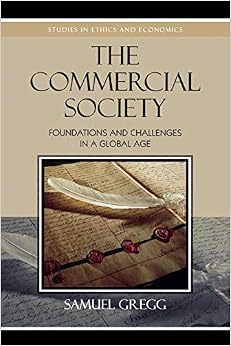
The Commercial Society: Foundations and Challenges in a Global Age: Foundations and Challenges in a Global Age (Studies in Ethics and Economics), by Samuel Gregg

Download The Commercial Society: Foundations and Challenges in a Global Age: Foundations and Challenges in a Global Age (Studies in Ethics and Economics), by Samuel Gregg
Remarkably, The Commercial Society: Foundations And Challenges In A Global Age: Foundations And Challenges In A Global Age (Studies In Ethics And Economics), By Samuel Gregg that you actually wait on now is coming. It's considerable to wait on the agent as well as advantageous books to read. Every publication that is given in better method and also articulation will be anticipated by many peoples. Even you are a good reader or not, feeling to read this book will certainly always show up when you find it. However, when you feel difficult to locate it as your own, exactly what to do? Borrow to your good friends and have no idea when to repay it to her or him.
The Commercial Society: Foundations And Challenges In A Global Age: Foundations And Challenges In A Global Age (Studies In Ethics And Economics), By Samuel Gregg is exactly what we at to share to you. This book will not obligate you to even review guide exactly. It will be done by providing the ideal choice of you to assume that analysis is always required. With the smooth language, the lesson of life is presented. Even this is not the particular publication that you probably like, when checking out guide, you could see why lots of people love to read this.
So, this is exactly what this publication supplies to you. You might take no notice of this information regarding The Commercial Society: Foundations And Challenges In A Global Age: Foundations And Challenges In A Global Age (Studies In Ethics And Economics), By Samuel Gregg Disregarding the benefits of this publication will escort you to regret. Yeah, the advantages of reading this book will be exact same with others. Enriching the experience, understanding, and also motivations are the common methods of you to check out some books. Yet, the additionally, the advantages will certainly be revealed from each publication when reading and completing it.
If you have actually determined to get this publication as the reading resource, now you can spend you couple of time to visit the page and also obtain guides. After analysis, you will definitely know why the factors we share it as one of the suggested superb books in this globe. Now, let's do more and also make real of The Commercial Society: Foundations And Challenges In A Global Age: Foundations And Challenges In A Global Age (Studies In Ethics And Economics), By Samuel Gregg to obtain.
Review
The Commercial Society is one of those books which reminds us that commerce, trade, and free economies are deeply rooted in foundations that we tend to take for granted - until they disintegrate or are taken away. Gregg's message of commercial humanism is truly inspiring, and his warnings about its fragility bear repeating. (Robert A. Sirico, President, Acton Institute)So much of Latin America continues to suffer the ravages of mercantile, neo-corporatist attitudes, policies, and institutions. Unless there is an systematic embrace of the type of moral, legal, and economic order described in Gregg's Commercial Society, populism will become the norm, corruption will continue to flourish, and untold millions who yearn only to express their economic creativity will continue to live in sub-human conditions. A well-written, easy to comprehend text that does not shy away from explaining complex issues. (Ricardo Crespo, Universidad Austral, Argentina)Gregg has contributed a major work to the growing literature in the field of the commerical society and its relationship to ethical and cultural foundations. (Ethics and Economics)An excellent study of economic liberty, its essential prerequisites, and its greatest challenges today. Everyone can learn something from this, especially those Europeans whose countries are mired in bureaucracy, stagnation, and what Tocqueville called "soft despotism." (Mart Laar, Former Prime Minister of Estoria)
Read more
About the Author
Samuel Gregg is director of research at the Acton Institute in Grand Rapids, Michigan.
Read more
Product details
Series: Studies in Ethics and Economics
Paperback: 196 pages
Publisher: Lexington Books (December 25, 2006)
Language: English
ISBN-10: 073911994X
ISBN-13: 978-0739119945
Product Dimensions:
6 x 0.5 x 9 inches
Shipping Weight: 10.4 ounces (View shipping rates and policies)
Average Customer Review:
5.0 out of 5 stars
3 customer reviews
Amazon Best Sellers Rank:
#931,699 in Books (See Top 100 in Books)
Simply superb.
Gregg has written an excellent book. This book, in it essence, is a very lucid scholarly, accurate historical-conceptual study of the causal correlations between the commercial society and what Gregg calls its "foundations", meaning the conditions that favor the commercial society. These include moral foundations (e.g., creativity, practical wisdom, trust, civility), economic foundations and legal-political foundations. But to read this book merely as a descriptive study is to miss the more important prescriptive thesis, which is that we ought to encourage and promote the commercial society. Beware, again of missing the important prescriptive thesis if one reads in Gregg merely the suggestion that an appropriate culture supporting these foundations( which intellectuals have a role to shape) needs to be defended and encouraged *in order to* have a commercial society. Rather the equally interesting, if not more interesting proposal, is that one might promote the commercial society *in order to* promote those desirable moral, economic and legal political foundations, which have themselves independent value, and which constitute a culture of civility. So what turned out originally to be means for the sake of the end (i.e., the commercial society) are now proposed as the ends worth seeking via the establishment of the commercial society. Gregg does not harbour pie-in-the-sky illusions: there remains many fine-tuning to be done, and he is alert to these, as seen in his careful qualifications. But this strategy for promoting the culture of civility, if I may, by way of the commercial society needs to be explored, since the causal correlative connections are much in evidence. In inviting us to think this way, Gregg is offering us an example of what Herbert Simon (Nobel Prize in economics, 1978) calls goaless designing (The Sciences of the Artificial, 1983), which he recommends as a fully rational and creative way of designing and engineering society. One seeks a solution (A) for a certain problem (B), but along the way, one discovers that the solution (B) itself is a desirable end, and one can reasonably pursue that (B) instead as the end of the design. Social planning, which aims to improve society, can certainly develop in this way, and the social planner or designer has to be alert, like an entrepreneur, to possibilities, consequences and hence opportunities that result from his solution, and to consider if the solution and the consequences might not itself be worth seeking, and not merely valuable instrumentally. If it is independently valuable, then it might in fact be sought after as the end goal, and what formerly was the end may now be sought instrumentally for the sake of the new end goal, to the extent that there is evidence that they mutually support each other. Gregg's The Commercial Society is just one such kind of design solution for improving the society. Thus it constantly invites us not merely to consider defending the foundations and civil cultures for the sake of the commercial society, but rather that we might consider crafting and engineering the commercial society for the sake of such a civil culture. Gregg pursues here, one might add, a way of thinking found in Michael Novak's works where he invites us to consider the way commercial society requires (and hence promotes) human creativity, which then can be ordered towards imaging God's own creativity. Whether one fully agrees with Gregg or not, one will have to take this work seriously. This is a fine text to challenge policy thinking that many times is senselessly linear and uncreative. Gregg was awarded the very prestigious Culture of Enterprise Award for this book. I am not at all suprised.
Drawing upon ancient and modern sources, "The Commercial Society" is one of those books that remind us that commercial order is about much more than the market economy. Using clear language free of jargon, this prize-winning book (Templeton Enterprise Award 2007) identifies the central moral, legal, and economic foundations of market orders and illustrates why they are indispensable to any society that aspires to the title of free and civilized.Many have been waiting for such a book for a long time. Not since reading Wilhelm Ropke have I come across a book that articulates such a strong and morally-convincing case for free societies shaped decisively by the dominance of free enterprise and markets, but in a way that escapes the mathematical justifications offered by most contemporary economists.It is difficult to classify this book as "conservative" or "classical liberal", not least because the author utilizes sources from both traditions, such as Edmund Burke, Adam Smith, Friedrich von Hayek, and Alexis de Tocqueville. It is, in short, a book grounded firmly in various strands of the Western tradition, especially that synthesized in the Scottish Enlightenment, but prefigured by a number of late-medieval and early-modern thinkers, such as Thomas Aquinas. It is refreshing to read a text that is so unambiguously committed to authentic human liberty, but which cannot be boxed so easily in any one intellectual paradigm.Those inclined to planned economies or socialism will find this book very challenging to their core beliefs. "The Commercial Society", however, does not seek to persuade by hectoring. Nor does it suggest that commercial order contains all the answers to humanity's questions and problems. Rather, it expresses its arguments through logic, by carefully marshaling the facts, and judiciously surveying history. The book closes with a sophisticated discussion of the possibility of building commercial orders as opposed to simply letting them evolve. It is one of the most intriguing discussions I have read of a problem that has puzzled thinkers such as Smith, Montesquieu and Tocqueville - this alone makes the book worth reading.
The Commercial Society: Foundations and Challenges in a Global Age: Foundations and Challenges in a Global Age (Studies in Ethics and Economics), by Samuel Gregg PDF
The Commercial Society: Foundations and Challenges in a Global Age: Foundations and Challenges in a Global Age (Studies in Ethics and Economics), by Samuel Gregg EPub
The Commercial Society: Foundations and Challenges in a Global Age: Foundations and Challenges in a Global Age (Studies in Ethics and Economics), by Samuel Gregg Doc
The Commercial Society: Foundations and Challenges in a Global Age: Foundations and Challenges in a Global Age (Studies in Ethics and Economics), by Samuel Gregg iBooks
The Commercial Society: Foundations and Challenges in a Global Age: Foundations and Challenges in a Global Age (Studies in Ethics and Economics), by Samuel Gregg rtf
The Commercial Society: Foundations and Challenges in a Global Age: Foundations and Challenges in a Global Age (Studies in Ethics and Economics), by Samuel Gregg Mobipocket
The Commercial Society: Foundations and Challenges in a Global Age: Foundations and Challenges in a Global Age (Studies in Ethics and Economics), by Samuel Gregg Kindle
