


 December 04, 2017


PDF Download Justice: What's the Right Thing to Do?
To assist you starting to have reading routine, this Justice: What's The Right Thing To Do? is offered currently. With any luck, by providing this book, it could attract you to begin discovering and also reading routine. When you discover a brand-new publication with intriguing title and also renowned writer to check out, exactly what will you do? If you only reviewed based on the specific theme that you like, really it is no mater. The matter is that you truly do not intend to attempt analysis, even just some pages of a thick publication.
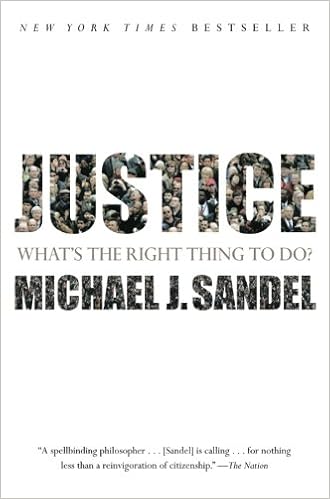
Justice: What's the Right Thing to Do?

PDF Download Justice: What's the Right Thing to Do?
Do you require brand-new reference to accompany your extra time when going to home? Checking out a book can be a good choice. It could save your time usefully. Besides, by reviewing book, you could improve your knowledge and experience. It is not only the science or social understanding; numerous points can be gotten after checking out a publication.
When it needs considerations to pick such publication to review in describing the major problem that you have now, you need to try with this book. Justice: What's The Right Thing To Do?, nonetheless, becomes a proffered publication doesn't mean that this book is hardly thoughtfully. You can change your mind approached the best publication will showcase the most difficult language as well as words to recognize. This instance will certainly certainly make rubbish for some people.
From guide, you will realize that reading is definitely should do. It will direct you to get more priceless spending time. By reviewing the books, your hung out will certainly not throw away incorrectly. You can discover exactly what you need and want to observe. Here, the Justice: What's The Right Thing To Do? becomes a choice to read guide due to the fact that it offers you the impressive features of the life. Even it is just the agent are for getting this type of book, you could see just how you could delight in the book specifically.
For more intriguing reason, you may unknown regarding the web content of this publication, may you? Why do not you try to understand? Recognizing new point will result in conceive the life better. You could not only review as the activities, however analysis can be a way to make your life run well. By this Justice: What's The Right Thing To Do? you can truly envision how the life will certainly be and also must be.
Review
“[Sandel] The most famous teacher of philosophy in the world [has] shown that it is possible to take philosophy into the public square without insulting the public's intelligence.†―Michael Ignatieff, The New Republic“Michael Sandel. . . is currently the most effective communicator of ideas in English.†―The Guardian“This book is absolutely indispensable for anyone who wants to be a good citizen. It shows how to balance competing values, a talent our nation desperately needs nowadays.†―Walter Isaacson, author of Benjamin Franklin: An American Life“More than exhilarating; exciting in its ability to persuade this student/reader, time and again, that the principle now being invoked--on this page, in this chapter--is the one to deliver the sufficiently inclusive guide to the making of a decent life.†―Vivian Gornick, Boston Review“Sandel explains theories of justice . . . with clarity and immediacy; the ideas of Aristotle, Jeremy Bentham, Immanuel Kant, John Stuart Mill, Robert Nozick and John Rawls have rarely, if ever, been set out as accessibly . . . In terms we can all understand, Justice confronts us with the concepts that lurk, so often unacknowledged, beneath our conflicts.†―Jonathan Rauch, The New York Times“Sandel dazzles in this sweeping survey of hot topics . . . Erudite, conversational and deeply humane, this is truly transformative reading.†―Publishers Weekly, starred review“A spellbinding philosopher . . . For Michael Sandel, justice is not a spectator sport . . . He is calling for nothing less than a reinvigoration of citizenship.†―Samuel Moyn, The Nation“Michael Sandel, perhaps the most prominent college professor in America, . . . practices the best kind of academic populism, managing to simplify John Stuart Mill and John Rawls without being simplistic. But Sandel is best at what he calls bringing ‘moral clarity to the alternatives we confront as democratic citizens' . . . He ends up clarifying a basic political divide--not between left and right, but between those who recognize nothing greater than individual rights and choices, and those who affirm a ‘politics of the common good,' rooted in moral beliefs that can't be ignored.†―Michael Gerson, Washington Post“Justice, the new volume from superstar Harvard political philosopher Michael Sandel, showcases the thinking on public morality that has made him one of the most sought-after lecturers in the world.†―Richard Reeves, Democracy“Hard cases may make bad laws, but in Michael Sandel's hands they produce some cool philosophy . . . Justice is a timely plea for us to desist from political bickering and see if we can have a sensible discussion about what sort of society we really want to live in.†―Jonathan Ree, The Observer (London)“Every once in a while, a book comes along of such grace, power, and wit that it enthralls us with a yearning to know what justice is. This is such a book.†―Jeffrey Abramson, Texas Law Review“Using a compelling, entertaining mix of hypotheticals, news stories, episodes from history, pop-culture tidbits, literary examples, legal cases and teachings from the great philosophers--principally, Aristotle, Kant, Bentham, Mill and Rawls--Sandel takes on a variety of controversial issues--abortion, same-sex marriage, affirmative action--and forces us to confront our own assumptions, biases and lazy thought. Sparkling commentary from the professor we all wish we had.†―Kirkus Reviews, starred review“Michael Sandel is . . . one of the world's most interesting political philosophers. Politicians and commentators tend to ask two questions of policy: will it make voters better off, and will it affect their liberty? Sandel rightly points out the shallowness of that debate and adds a third criterion: how will it affect the common good?†―Guardian“Michael Sandel transforms moral philosophy by putting it at the heart of civic debate . . . Sandel's insistence on the inescapably ethical character of political debate is enormously refreshing.†―Edward Skidelsky, New Statesman“A remarkable educational achievement . . . Generations of students and educated citizens will be very well served by Sandel's introductory overviews.†―Amitai Etzioni, Hedgehog Review“Reading Justice by Michael Sandel is an intoxicating invitation to take apart and examine how we arrive at our notions of right and wrong . . . This is enlivening stuff. Sandel is not looking to win an argument; he's looking at how a citizen might best engage the public realm.†―Karen R. Long, Cleveland Plain Dealer“A road map for negotiating modern moral dilemmas . . . For those seeking a short course through moral philosophy from a witty writer, fast on his feet, and nimble with his pen, this thin volume is difficult to beat.†―Kevin J. Hamilton, Seattle Times“Michael Sandel, political philosopher and public intellectual, is a liberal, but not the annoying sort. His aim is not to boss people around but to bring them around to the pleasures of thinking clearly about large questions of social policy. Reading this lucid book is like taking his famous undergraduate course ‘Justice' without the tiresome parts, such as term papers and exams.†―George F. Will, syndicated columnist“Justice is Sandel at his finest: no matter what your views are, his delightful style will draw you in, and he'll then force you to rethink your assumptions and challenge you to question accepted ways of thinking. He calls us to a better way of doing politics, and a more enriching way of living our lives.†―E. J. Dionne, syndicated columnist“There have been various attempts over the decades to bury moral philosophy -- to dismiss convictions about right and wrong as cultural prejudices, or secretions of the brain, or matters so personal they shouldn't even affect our private lives. But moral questions always return, as puzzles and as tragedies. Would we push a hefty man onto a railroad track to save the lives of five others? Should Petty Officer 1st Class Marcus Luttrell, in June of 2005, have executed a group of Afghan goatherds who, having stumbled on his position, might inform the enemy about his unit? (Luttrell let them go, the Taliban attacked, and three of his comrades died.) These examples and others -- price-gouging after Hurricane Katrina, affirmative action, gay marriage -- are all grist for the teaching of Michael Sandel, perhaps the most prominent college professor in America. His popular class at Harvard -- Moral Reasoning 22: Justice -- attracts about a sixth of all undergraduates. For those lacking $49,000 a year in tuition and board, he has written "Justice: What's the Right Thing to Do?" which has been further translated into a PBS series and a Web site, JusticeHarvard.org.†―Michael Gerson, The Wall Street Journal
Read more
About the Author
Michael J. Sandel is the Anne T. and Robert M. Bass Professor of Government at Harvard University, where he has taught since 1980. He has taught his undergraduate course "Justice" to more than 15,000 Harvard students over the years, and video footage of the course was adapted into a PBS television series. Sandel graduated summa cum laude from Brandeis University and received his doctorate from Oxford University, where he was a Rhodes Scholar. He served on the George W. Bush administration's President's Council on Bioethics. He lives in Brookline, Massachusetts.
Read more
Product details
Paperback: 320 pages
Publisher: Farrar, Straus and Giroux; Reprint edition (August 17, 2010)
Language: English
ISBN-10: 9780374532505
ISBN-13: 978-0374532505
ASIN: 0374532508
Product Dimensions:
5.6 x 0.8 x 8.3 inches
Shipping Weight: 9.6 ounces (View shipping rates and policies)
Average Customer Review:
4.6 out of 5 stars
524 customer reviews
Amazon Best Sellers Rank:
#9,195 in Books (See Top 100 in Books)
I read this book expecting another dish of the same warmed-over relativism that is so often churned out by philosophy professors these days. This book shocked me by championing two revolutionary (for the last century at least) ideas. First of all, Sandel takes his time getting there, but eventually he outlines a philosophy rooted in the idea that right and wrong not only exist, but that we as a society should be teaching and encouraging "right" over "wrong". Too often these days we are barraged with relativistic personal philosophies rooted in "what is right for you may not necessarily be right for me". Where does this end? It ends with moral decay so severe that we have advocacy groups for pedophiles and racists. For our society to rebound, we must teach the next generation that there is a right and wrong and then, onto Sandel's second idea, we must engage in open debate and conversation to parse out exactly how we are to go about living them out.Can you believe that? Truly revolutionary. Who would have thought that it would be a good idea to openly debate the deepest, most far reaching issues of our time? I was raised with the idea that you never, ever discuss religion or politics with anyone. Sandel recommends that to truly find the truth requires vigorous discussion between well schooled, experienced people who can help our society wade through all of the moral minefields we encounter daily. He is not selling a system by which to measure right and wrong like pounds of flour. But a living organism of a society that processes ideas in a forum that leads to informed decisions. Could you imagine a television channel where the best minds in the world in philosophy, religion, ethics, political science, etc. would verbally spar while thousands watched? I would pay money for that. Instead we are subjected to slanted reporting (from virtually any perspective you want) that never requires the talking heads to give a straight answer for anything and simply reinforces the mindset the viewer already possesses. If you have ever wasted time watching C-SPAN, you understand that the people running our country couldn't win a debate in an Alabama middle school competition, let alone provide sound leadership through some of the most challenging ethical issues in the history of humankind.Think about it for a minute. If there were such a channel would anyone even want to watch it? If they did watch it, would they even be able to keep up with what it was about? Does the average person even have the basic vocabulary to appreciate a great debate? I don't think so. Even after college, I had to read vigorously myself to gain even a minimal understanding of sound thinking. Did you have an ethics course in high school? Did you take anything even remotely resembling logic, the science of correct thinking? God forbid you might take a course giving an overview of the greatest thinkers/ideas in history. That might help you make good, sound decisions in the future.Overall, Justice brings up some very interesting moral dilemmas, outlines the most popular moral philosophies of our day (Mill and Rawls) and then sort of sheepishly proposes a philosophy of right and wrong that is hashed out in the public square. At times he comes across as a bit naive, but I was left with the sense that Michael Sandel truly wants to make this world a better place by helping us all get acquainted with the process of vigorous, meaningful debate and the fruit of making right choices. He understands the fact that doing the right thing rarely has selfish motives and always requires character and strength. It is about time we had a philosopher step forward and take a stand that could actually bring about some positive change for our society.
The point of the book is to introduce some pretty basic jurisprudence/moral philosophy, and the idea that common social issues should be argued with morals and ethics--in fact, they can't be excluded from discussions. If you're not familiar with a lot of the basic philosophical theories that are referenced in socio-political discussions (Kant, Utilitarianism, Aristotle, etc.), the book will be helpful.I found that Sandel repeats himself frequently, and uses a lot of short stories to explain a concept. It felt more circular and kind of energy-draining to try and find out the point he was trying to make. Additionally, he doesn't go into any real depth with the theories, just mentions a few basic points and then goes right into another hypothetical.
ScienceThrillers Review: I never took Sandel’s famous core curriculum course while I was at Harvard, but many undergraduates did. There was something special about that class: people talked about it, and kept talking about it. Sandel was accomplishing what all educators wish they could. He was lighting a fire.Now, years later, Professor Sandel has written a book based on the content of that course which has now become famous beyond the ivy walls. Which means I had a second chance to be his student. (Or third chance, if you consider I rejected the idea of enrolling in the online edX version of Justice as too onerous.)No one would describe Justice as a beach read, but I did read it on vacation, an advantage that allowed me to focus more fully and not abandon the book for too-long intervals. It is a page-turner in its own way. Sandel’s gift is two-fold. First, he streamlines the key arguments and perspectives of a select group of great moral philosophers. The ideas aren’t dumbed down, but they are artfully reduced to their essence. Second, he uses real-world anecdotes to illustrate the application of the various philosophies, and equally important, he explains the intellectual challenges made to each. (Which allowed me to pretend that’s exactly what I was thinking and I was glad he brought it up.)Moral issues used in the book include the famous runaway trolley problem, outrage over the bailout, exploding gas tanks in Ford Pintos, a consensual cannibalism case from Germany, the voluntary military, surrogate pregnancy, selling kidneys, Bill Clinton and Monica, affirmative action, reparations, evacuating Ethiopian Jews, buying American, and much more. In each case, although Sandel is clearly a contemporary American liberal, he avoids taking a decisive stand but works through the logical conclusion of the relevant moral philosophy.Thus about 80% of the book is an engaging, readable distillation of important ideas about justice, society, and morality. In the last 20% or so, Sandel goes beyond teaching and presents his own argument for a new approach to justice in our times. Once you wrap your head around it, you realize that he is advocating for a revolutionary re-thinking of the moral neutrality which has been the unwritten goal of justice in America for some decades. His is a bracing, risky gambit–but once you’ve read the whole book, you’ll see why it may be the only way to save modern politics.A remarkable, compact book that will stimulate the logic circuits of your brain and leave you pondering Big Questions.Unusual words: utilitarianism; Jeremy Bentham; John Stuart Mill; libertarianism; universal rights; laissez-faire; pure practical reason; Immanuel Kant; categorical imperative; intelligible realm; John Rawls; moral desert; Aristotle; telosIf you like Justice, you might like:The Righteous Mind: Why Good People Are Divided by Politics and Religion by Jonathan Haidt.
This is an immensely readable refresher of the principles pertaining to justice as written by a wide array of philosophers, from Aristotle to Rawls. Ultimately, Mr. Sandel argues convincingly that what the right thing is cannot be separated entirely from the hazards of our genes, education and circumstances and that discussions of moral matters require more than considerations of utility and consent. To Sandel, there is a civic dimension to justice that too few attempt to engage. These are thought provoking ideas brought forth in examinations of some very contentious modern issues from immigration to affirmative action to abortion, you name it.However, the most beautiful thing about the book for me was the self-reflection it promoted in me as I tried to engage the questions as rigorously as I could. Doing that, in the first instance, is the Right Thing to Do, I think.
Justice: What's the Right Thing to Do? PDF
Justice: What's the Right Thing to Do? EPub
Justice: What's the Right Thing to Do? Doc
Justice: What's the Right Thing to Do? iBooks
Justice: What's the Right Thing to Do? rtf
Justice: What's the Right Thing to Do? Mobipocket
Justice: What's the Right Thing to Do? Kindle
0 comments:
Post a Comment