


 May 20, 2019


Free PDF Microsound (The MIT Press)
Checking out will not only meet your time easily. It will certainly give the means as well as numerous points that can be done when analysis. Obtaining the realities, amusement, lesson, and also knowledge can be gotten to easier by reviewing the book. You may not just have to save you time for your friend or family. In some cases, investing few times for reading will be also valuable.
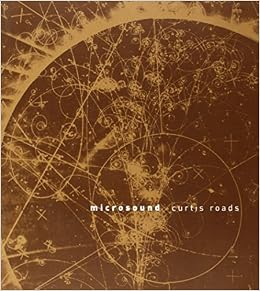
Microsound (The MIT Press)

Free PDF Microsound (The MIT Press)
Taking into consideration concerning the excellences will need certain facts and sights from some sources. Currently we offer Microsound (The MIT Press) as one of the resources to think about. You may not neglect that book is the best source to address your issue. It can aid you from lots of sides. When having such issue, obtaining the right publication is much required. It is to make bargain and matched to the issue and also how you can resolve it.
Microsound (The MIT Press) turns into one of the hundred publications that we offer in soft file types. Also this is simply saved, it will certainly make you complete to have a publication. It will certainly not make you really feel dizzy to bring guide alike the very publication fan. You could just read the soft file in the device. So, it will facilitate for you to read as well as computer when at workplace and also residence. The soft data can be replicated for some places as your own.
Also you have guide to read just; it will not make you really feel that your time is really limited. It is not only about the time that could make you really feel so preferred to join guide. When you have picked guide to check out, you can save the moment, also couple of time to constantly read. When you assume that the moment is not just for obtaining guide, you could take it here. This is why we pertain to you to offer the simple ways in obtaining the book.
Once again, reviewing behavior will constantly provide valuable benefits for you. You might not need to invest sometimes to check out the book Microsound (The MIT Press) Simply set apart a number of times in our extra or downtimes while having dish or in your workplace to read. This Microsound (The MIT Press) will certainly show you brand-new thing that you could do now. It will certainly assist you to boost the top quality of your life. Occasion it is simply an enjoyable book Microsound (The MIT Press), you can be healthier as well as a lot more fun to delight in reading.
Review
Microsound is packed with insight and stimulating ideas.―Douglas Geers, Electronic Musician
Read more
Review
The 'final frontier' of computer music is undoubtedly microsound―the quantum level of acoustics―and Curtis Roads boldly leads us into this new domain, which will become increasingly important in the twenty-first century. In providing the history, theory, and compositional practice of the micro scale of sound design, Roads clearly lays out the roadmap to this exciting and challenging area of digital research. The book is destined to become the standard reference in the field for years to come.―Barry Traux, Professor, Simon Fraser UniversityThe best survey to date of real-time machine techniques for musical composition, performance, and improvisation.―Miller Puckette, Professor, Department of Music, University of California San DiegoMicrosound offers an enticing series of slice 'n' dice audio recipes from one of the pioneering researchers into the amazingly rich world of granular synthesis. I can't wait to try these at home.―David Zicarelli, founder and president, Cycling '74Roads has assembled a thorough survey of software and techniques for granular synthesis, and provides a useful discussion of related musical practices and aesthetic implications that arise.―Miller Puckette, Professor, Department of Music, University of California San Diego
Read more
See all Editorial Reviews
Product details
Series: The MIT Press
Paperback: 424 pages
Publisher: The MIT Press; PAP/CDR edition (August 20, 2004)
Language: English
ISBN-10: 0262681544
ISBN-13: 978-0262681544
Product Dimensions:
8 x 0.8 x 9 inches
Shipping Weight: 1.8 pounds (View shipping rates and policies)
Average Customer Review:
4.1 out of 5 stars
12 customer reviews
Amazon Best Sellers Rank:
#77,822 in Books (See Top 100 in Books)
Do you want the clearest explanation of what a glisson is? You'd better buy this book. No one else will be able to tell you because it was invented by Curtis Roads. If you want the quick version, though, it's a glissando windowed to the size of a grain; i.e., if you've ever run a short sine sweep through a delay, you've already worked with the sonic equivalent of a synchronous cloud of them. 75% of the book could be described this way - sound generation so simple you could hit on it by accident, presented with industry-ignored jargon you can only get here. A large part of what remains is empty philosophizing/metaphor - i.e. the first 80 pages trace, among other things, the development of atomistic thought as applied to actual atoms. E.g., Roads mentions that we originally thought the atom was indivisible before we found its constituent components. Can his grains be subdivided further? We wouldn't know. He didn't ask; he simply drew a questionable tie between his compositional experiments and the fundamental forces of the universe. Quite a bit of this book is also dedicated to reproducing, in less detail, the documentation for various synthesis methods available to readers. Why read Roads' summary of CSound's granular synthesis algorithms? He doesn't go to the same level of detail, CSound and multiple versions of its manual are free, and his knowledge of the program is now almost eighteen years out of date. This book might inspire the odd idea, but I'd be surprised if there were someone who couldn't productively experiment before reading this and could after.
Truly fascinating. Curtis Roads wrote the book on Microsound before he wrote the book called Microsound. Fans of bit reduction, glitch, noise, wavetable and granular synthesis will find intellectual nirvana.
This is probably the best (and one of the only) books that delves into particle sound synthesis. If you have a passing interest in eclectic composition or audio programming, you'll want this book.
Great book, an excellent view of music and sound down to a microscopic level. Full of interesting ideas, and a lot of examples of contemporary practitioners in the field.
One of Roads' masterpieces
Many people today seem to be obsessed with recreating 'classic' sounds, whether it's Minimoogs, TB303s or even traditional orchestral instruments. So it's refreshing to find that there are still people out there intent on pushing the boundaries of synthesis further and creating new sounds. Curtis Roads has done more than most in this field, and this book on granular synthesis that he has authored is a fairly comprehensive guide to the subject.Roads' involvement with granular synthesis began in 1972, and his research in the field has resulted in him eventually developing his own software. Granular synthesis deals with sound at a 'quantum' level: the sonic atom being the individual sample (any one of the 44100 taken in a second at the standard sampling rate). To be audible as anything other than a click, samples need to be grouped together to form grains of sound. These grains are typically anywhere between three and one hundred milliseconds in length. Granular synthesis is concerned with the organization and processing of both samples and grains to create sounds that are often far beyond the range of more traditional methods of synthesis.The technology and software required to manipulate sound at this level is now commonly available. Popular programs like Chaosynth and Max/MSP offer in-depth granular facilities, and Roads' own programs, Pulsar Generator and Cloud Generator, are, as you might expect, specifically designed for this sort of application. Although this technology has made it possible, granular synthesis remains a complex process. Microsound is perhaps the best theoretical and practical guide to date, its 409 pages concisely and fluently written throughout. The first chapters outline basic time scales in musical structure and the history and theory of microsound. Chapters three to six deal with the theory and practice of granular synthesis, examining everything from the organisation and processing of grains to the implementation of micro-scale transformations. The later chapters explore the implications and aesthetics of composing with microsound. The book concludes with a brief chapter about the future of granular synthesis. If there is any fault with this book, it is that it may be rather academic in tone for some readers - it is not a 'how to' book. However, if you are seriously interested in exploring granular synthesis, and understanding the principles behind it, then this book is ideal.For those readers who would like to get their hands dirty themselves and try programming granular synthesis compositions, you might want to look up Jass and jMusic on the web. Jass is a unit generator based audio synthesis programming environment written in pure Java. Jass requires Java 1.5. jMusic is a freeware API that supports both real-time and non-real-time granular synthesis. jMusic has extensive tutorials and example programs available online.I notice that Amazon does not show the table of contents for this book, so I do that here:Introduction **Acknowledgments ixOverview **1. Time Scales of Music **2. The History of Microsound from Antiquity to the Analog Era 433. Granular Synthesis 854. Varieties of Particle Synthesis 1195. Transformation of Microsound 1796. Windowed Analysis and Transformation 2357. Microsound in Composition 3018. Aesthetics of Composing with Microsound 3259. Conclusion 349References 353Appendix A: The Cloud Generator Program 383Appendix B: Sound Examples on the CD 389NOTE: Sections marked by "**" have sample chapters available at the book's website at MIT Press.
Curtis Roads has been working with Granular Synthesis since 1972, following the work of Iannis Xenakis and Dennis Gabor. His decades of research and computer programs in this field have educated and inspired all electronic musicians who work within the particle synthesis field. My first introduction to Granular synthesis was Roads' article from a 1978 issue of the Computer Music Journal entitled 'Automated Granular Synthesis of Sound'.Microsound marks a milestone in granular synthesis and contains a huge amount of information, relating to it and other forms of particle synthesis, some of which were a direct result of Roads' own research (eg glisson synthesis). The book contains a full history of particle synthesis going back to the early philosophies aroused by the debate of whether sound is a particle or wave, right through to his own recent experiments and instruments. It gives full details on how to work with granular synthesis and also contains a CD full of examples, including some very historically significant pieces of music.The writing style is easy to follow, including a few humourous anecdotes - well I found them humourous, Roads probably found them frustrating at the time, although I am sure he smiles about it now :)There are a couple of minor quoting errors, but they do not misconstrue the meaning and are not noticeable unless you are going through the book with a fine tooth comb (like I did).For anyone interested in working with sound at a low (microsound) level, this is a MUST READ book!To any reviewers who do not understand all of the terms used, perhaps you should re-read Microsound and also any literature written on this topic in the last 30 years.
Microsound (The MIT Press) PDF
Microsound (The MIT Press) EPub
Microsound (The MIT Press) Doc
Microsound (The MIT Press) iBooks
Microsound (The MIT Press) rtf
Microsound (The MIT Press) Mobipocket
Microsound (The MIT Press) Kindle
0 comments:
Post a Comment